
How to Price a New Offer Before You Have Perfect Data
Nov 10, 2026
By Kristi Mitchell, My Venture Coach
Set a starting price by checking what the customer compares your offer with, what it costs to deliver, and the number of sales you can handle. Then test a defined offer and review the actual costs and buying responses.
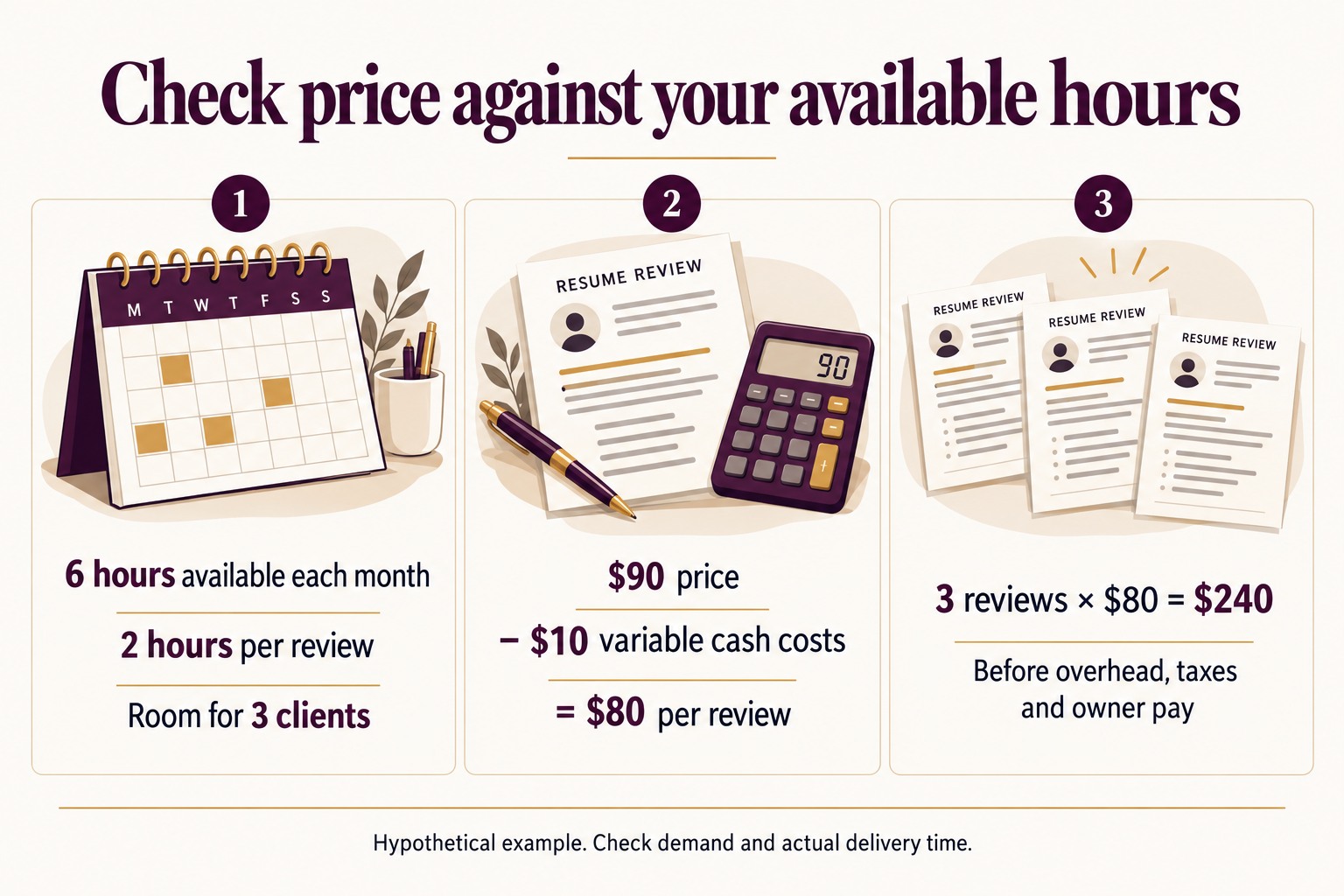
Consider a hypothetical founder who offers resume reviews alongside a job and caregiving. She can protect six hours a month for delivery. Each review takes two hours, including messages and revisions, so she has room for three clients.
At a $90 price and $10 in variable cash costs per review, she has $80 per sale left for overhead, taxes and her pay. Three reviews leave $240 before those obligations. She must decide whether that return fits her goal, and test whether customers will buy the defined review. If each client takes three hours, she needs to recalculate before promising the next slot.
These are hypothetical teaching numbers, not a suggested price or an earnings forecast. A workable starting price needs to fit the customer’s buying decision and the hours you can protect.
A useful starting price considers four things together:
- what the customer is trying to accomplish;
- what the customer compares your offer with;
- what it costs and requires to deliver;
- what the business needs to remain workable.
Use those four inputs to choose a starting price, then review it against real buying decisions and delivery costs.
Start with the customer's decision
Customers do not evaluate price in isolation. They compare it with another product, a do-it-yourself workaround, delay, an employee, a contractor, a larger provider or doing nothing.
Ask likely customers:
- How are you handling this now?
- What does that option cost in money, time or missed progress?
- What would make a different approach worth considering?
- Who approves the purchase?
- What evidence would reduce the risk of saying yes?
Do not ask only, "What would you pay?" A hypothetical number without an offer, tradeoff or buying context can mislead you.
Know the cost of keeping the promise
List the costs connected to one sale:
- materials, inventory and packaging;
- payment, marketplace or platform fees;
- shipping, travel or venue costs;
- contractor or employee time;
- your own preparation and delivery time;
- customer support, revisions and returns;
- taxes or required charges the business must bear;
- the share of insurance, software and overhead the offer needs to support.
Track your own hours even when you are not paying yourself yet. Separate the costs that rise with each sale from monthly overhead, so you do not count the same expense twice. Ask a bookkeeper or accountant how to handle taxes and any charges you must collect and remit.
Account for capacity
Two offers with the same direct cost may require different prices because they consume different amounts of founder attention.
If you can serve four clients a month, check whether the price supports the business at that volume. If your plan requires twenty clients but you can deliver well to eight, revise the scope, price or delivery model before accepting more work.
I would check available delivery slots before setting a sales target. If the target requires hours you cannot protect, revise the offer before taking bookings.
Capacity also includes the rest of your life. A side-hustle founder with five available hours needs a different delivery model from a full-time owner with a team.
Check the numbers for a product offer
For a hypothetical product seller, a $36 kit with $18 in variable costs leaves $18 per kit toward fixed costs and profit. With $90 in monthly fixed costs, five kits cover those fixed costs. That estimate excludes owner pay unless the seller has included it in the costs. The SBA's break-even guidance explains how to separate fixed and variable costs.
Choose a pricing logic you can explain
Common starting approaches include:
- cost plus: direct and allocated costs plus a margin;
- market referenced: a deliberate position relative to credible alternatives;
- value informed: price reflects the importance of the result and the customer's available alternatives;
- tiered: clear choices differ by scope, speed, access or support;
- pilot: a defined first version priced for limited scope and shared learning.
None removes judgment. Cost plus can ignore customer value. Copying competitors can repeat their bad economics. Value pricing becomes empty language if the result and evidence are vague. Tiers create confusion when the differences are cosmetic.
Put the number in a real conversation
Give an appropriate customer a real offer with a stated price, scope and buying step.
Watch what happens:
- Do they understand the result before asking the price?
- What do they compare it with?
- Does hesitation relate to money, timing, trust, scope or urgency?
- Can they take the next buying step?
- If they decline, what do they do instead?
Record each response and look for patterns among people who fit the customer and situation you chose.
Do not discount before you understand the objection
Lowering the price can hide a problem with the offer.
The customer may not see the relevance. The proof may be weak. The scope may be too broad. The buying process may feel risky. They may not be the buyer. The problem may not be urgent.
Before discounting, ask what would need to be clearer or different. If you change the price, define what you expect the change to teach you.
Make a starting-price note in 20 minutes
Use a notebook or one document. Write down:
| Customer and result | For ____ in the situation ____, I will deliver ____. |
|---|---|
| Current alternative | They use ____ now. It costs them ____ in money or time. |
| Scope and delivery time | Included: ____. Excluded: ____. Estimated hours per sale, including messages and revisions: ____. |
| Available capacity | Delivery hours I can protect per month: ____. Workable sales volume at those hours: ____. |
| Costs and money remaining | Variable cost per sale: ____. Monthly overhead: ____. At a price of ____, each sale leaves ____ before overhead, taxes, and owner pay, unless I included those in the costs. |
| Starting offer and reason | Price: ____. Customer alternatives, scope, and costs that support testing it: ____. |
| Buying test | I will present the defined offer to ____ by ____. I will record their response and any reason they share. |
| Review and decision | On ____, compare estimated and actual costs, hours, and buying responses. Keep testing / revise / pause because ____. |
Set a review date that fits your schedule. Compare your estimated costs and hours with the work you delivered. Keep the price for a further test if customers buy and you can deliver within your limits. Revise scope or delivery when the work exceeds the estimate. If likely buyers decline, ask about the reason before deciding whether to change the price. You can pause the offer if neither the customer response nor the economics supports another test.
For help preparing that conversation, read what to say in your first sales conversation.
About the author: Kristi Mitchell brings four decades of business experience. For 15 years, Kristi has taught entrepreneurship and worked directly with founders.
Deciding what to work on before launch? Take the free Business Next Step Quiz to find your Map, Launch or Grow starting point.
View The Entire Collection
Explore practical guides for mapping a venture, preparing to launch, and growing a business.